Production RAG Architecture: Next.js App Router, PostgreSQL HNSW Indexes, and Half-Precision Vector Streaming
Half-precision vectors to stay inside PostgreSQL page limits, SQL-native Reciprocal Rank Fusion, and streaming past reverse-proxy buffering.

Retrieval-Augmented Generation (RAG) architectures in enterprise environments demand a transition from isolated scripting to highly concurrent, fault-tolerant web infrastructure. When integrating heavy statistical retrieval mechanisms with asynchronous user interfaces, database memory limits and network transmission latency emerge as the primary engineering bottlenecks. The architectural baseline for modern implementations leverages PostgreSQL as a unified data ecosystem, utilizing the pgvector extension for high-dimensional state persistence alongside the Next.js App Router for streaming responses.
This analysis details the construction of a production-ready RAG pipeline. The focus remains strictly on optimizing PostgreSQL memory page limits through half-precision vector storage, implementing SQL-native Reciprocal Rank Fusion (RRF) for hybrid search mechanisms, and bypassing the reverse-proxy buffering constraints of Server-Sent Events (SSE) within the Next.js ecosystem.
High-Dimensional Data Persistence and Memory Page Optimization
Vector similarity search within PostgreSQL fundamentally alters the database's memory access patterns. While standard B-tree indexes are optimized for highly selective disk reads, Approximate Nearest Neighbor (ANN) indexes, specifically Hierarchical Navigable Small World (HNSW) graphs, require the active working set to remain entirely memory-resident within the shared_buffers or the operating system's page cache to achieve sub-millisecond query latency.
A standard embedding generated by contemporary models (such as OpenAI's text-embedding-3-small) consists of 1,536 dimensions. When stored as standard 32-bit floats (float32), a single vector consumes approximately 6,144 bytes of payload space. PostgreSQL utilizes fixed-size 8KB heap pages for data storage; a row cannot span multiple pages unless stored via TOAST mechanisms, which are detrimental to index scanning speeds. Factoring in pgvector's own 8-byte header on the value itself, which stores 4 * dimensions + 8 bytes per vector, a 6,152-byte datum dictates that only a single full-precision vector can reside on an 8KB page.
To resolve this architectural limitation, the implementation mandates the use of halfvec, a 16-bit floating-point format introduced in pgvector 0.7.0. Compressing the dimensions to 16 bits reduces the payload to 3,072 bytes. Combined with the header, the 3,080-byte footprint allows two vectors to fit precisely within a single 8KB page. This compression doubles the packing density, reduces disk I/O by 50%, and cuts the HNSW index size by half, with negligible degradation in search recall.
| Metric | Full Precision (vector, 32-bit) |
Half Precision (halfvec, 16-bit) |
Performance Delta |
|---|---|---|---|
| Payload per Row (1536 dims) | 6,144 bytes | 3,072 bytes | -50% Storage |
| Vectors per 8KB Page | 1 | 2 | +100% Density |
| Index Build Time (1M Rows) | 377 seconds | 163 seconds | -57% Compute Time |
| P99 Query Latency | 2.7 ms | 1.9 ms | -30% Latency |
| Recall @ K=10 | 0.945 | 0.945 | 0% Variance |
Data reflecting benchmark execution on 1,000,000 vectors representing dbpedia-openai-1000k-angular datasets.
Schema Definition and HNSW Parameter Tuning
Constructing the PostgreSQL schema requires precise configurations to accommodate these optimizations. The HNSW algorithm builds a multi-layered graph where each node represents a vector. The query routing starts at the top, sparser layers and navigates down to denser layers to locate nearest neighbors logarithmically.
When defining the index, the parameters m (maximum connections per node) and ef_construction (dynamic candidate list size during index build) dictate the density and accuracy of the graph. Setting m = 16 and ef_construction = 128 provides a mathematically sound balance between structural integrity and build performance for 1,536-dimensional spaces.
Building an HNSW index on millions of rows is an inherently memory-intensive operation. If the allocated maintenance_work_mem is insufficient to hold the entire graph structure during construction, PostgreSQL defaults to a disk-based sorting path, which can increase build times by a factor of 10 to 50. Furthermore, parallelizing the build is critical; adjusting max_parallel_maintenance_workers ensures all available CPU cores are utilized during the graph construction.
-- Enable the vector operations extension.
CREATE EXTENSION IF NOT EXISTS vector;

-- Initialize the document storage schema.
CREATE TABLE documents (
    id          BIGSERIAL PRIMARY KEY,
    content     TEXT NOT NULL,
    -- Utilizing 16-bit floats for memory optimization.
    embedding   HALFVEC(1536),
    -- Generated column synchronizing full-text search representations.
    fts         TSVECTOR GENERATED ALWAYS AS (to_tsvector('english', content)) STORED,
    created_at  TIMESTAMPTZ DEFAULT now()
);

-- Optimize parallel computation and maintenance memory allocations.
SET maintenance_work_mem = '4GB';
SET max_parallel_maintenance_workers = 4;

-- Construct the HNSW index concurrently to prevent table locking.
CREATE INDEX CONCURRENTLY idx_docs_hnsw
    ON documents
    USING hnsw (embedding halfvec_cosine_ops)
    WITH (m = 16, ef_construction = 128);

-- Construct the Generalized Inverted Index (GIN) for lexical search.
CREATE INDEX CONCURRENTLY idx_docs_fts
    ON documents
    USING gin (fts);
At query execution time, the PostgreSQL query planner evaluates whether to utilize the HNSW index or perform a sequential scan. The hnsw.ef_search parameter controls the candidate list size during the search phase. While a higher ef_search yields better recall, an excessively high value triggers the query planner's cost model to abandon the index entirely, reverting to a full table scan that causes execution times to spike from 2.5 milliseconds to over 360 milliseconds. Tuning ef_search to a bounded range (for example, 40 to 100) prevents this optimizer flip-flop.
Hybrid Retrieval via Reciprocal Rank Fusion (RRF)
Semantic vector search excels at conceptual matching but frequently fails at exact keyword retrieval, such as parsing specific alphanumeric error codes, UUIDs, or highly specialized domain nomenclature. A robust production system mitigates this by architecting a hybrid retrieval pipeline that combines dense vector embeddings with sparse lexical representations (BM25 or tsvector).
The conventional approach involves executing two separate queries, transporting the results to an external application server, and merging the lists programmatically. However, executing this logic natively within PostgreSQL eliminates network serialization overhead and reduces application-side memory pressure.
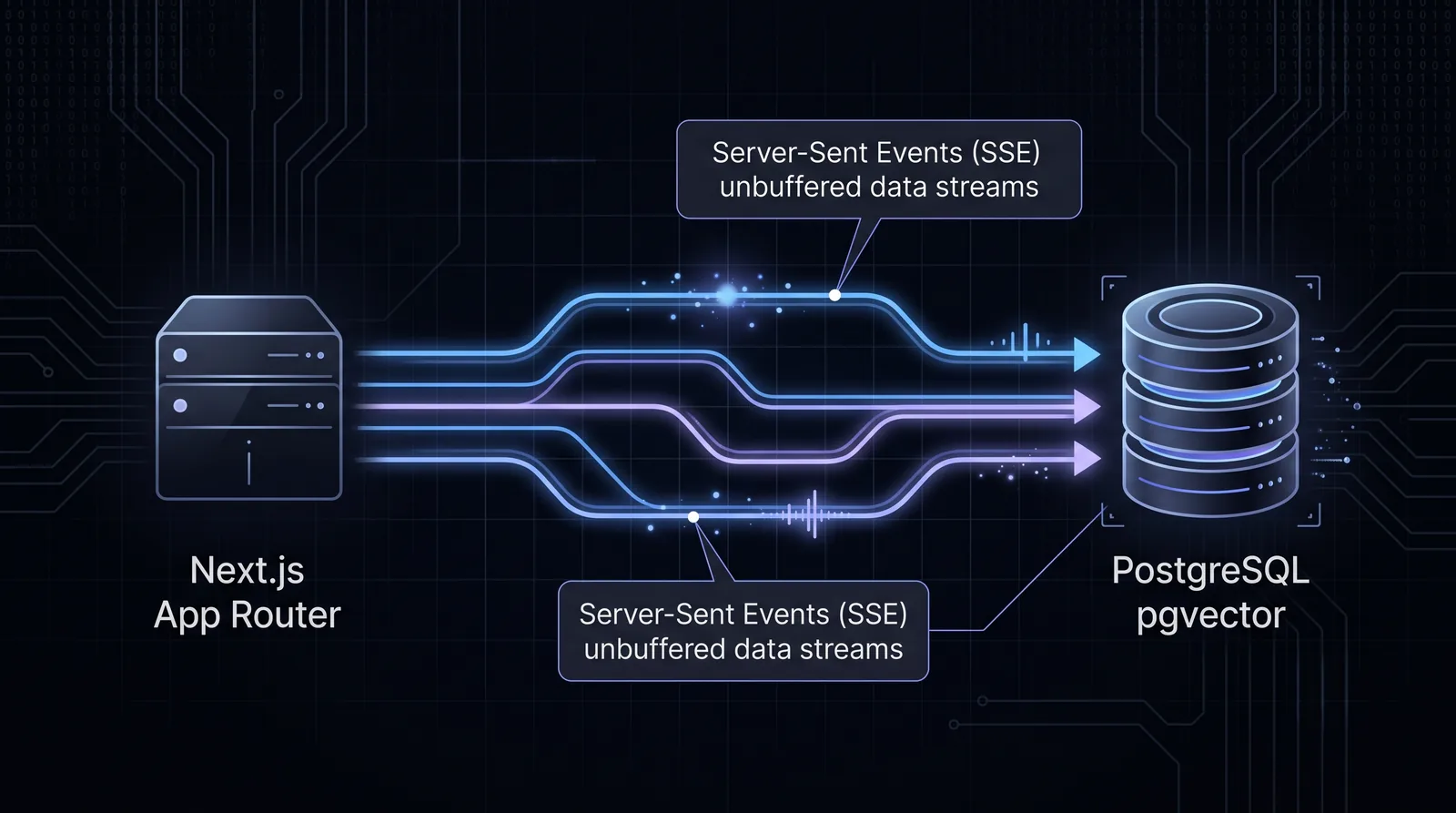
The optimal mathematical framework for this aggregation is Reciprocal Rank Fusion (RRF). RRF computes a unified score by summing the reciprocal of a document's rank across multiple independent retrieval methods. The formulation is defined as:
In this equation, represents the 1-based position of document within the sorted result list of retrieval method , and acts as a smoothing constant. The constant is empirically calibrated, with serving as the industry standard. This specific value provides a non-linear diminishing return: it ensures that top-ranked documents are heavily weighted, while lower-ranked documents contribute marginally, effectively breaking ties without allowing any single retrieval methodology to dominate the final output.
The SQL execution pattern relies on Common Table Expressions (CTEs) combined with a FULL OUTER JOIN to compute the RRF matrix dynamically.
WITH vector_search AS (
    SELECT id,
           content,
           ROW_NUMBER() OVER (ORDER BY embedding <=> $1::halfvec(1536)) AS rank
    FROM documents
    ORDER BY embedding <=> $1::halfvec(1536)
    LIMIT 20
),
text_search AS (
    SELECT id,
           content,
           ROW_NUMBER() OVER (ORDER BY ts_rank(fts, query) DESC) AS rank
    FROM documents, plainto_tsquery('english', $2) query
    WHERE fts @@ query
    ORDER BY ts_rank(fts, query) DESC
    LIMIT 20
),
combined AS (
    SELECT COALESCE(v.id, t.id)           AS id,
           COALESCE(v.content, t.content) AS content,
           -- Applying the RRF calculation with k = 60.
           (COALESCE(1.0 / (60 + v.rank), 0.0) +
            COALESCE(1.0 / (60 + t.rank), 0.0)) AS rrf_score
    FROM vector_search v
    FULL OUTER JOIN text_search t ON v.id = t.id
)
SELECT id, content, rrf_score
FROM combined
ORDER BY rrf_score DESC
LIMIT 5;
This query guarantees that even if a document is exclusively retrieved by the vector search and entirely missed by the lexical search, its partial score is evaluated correctly, allowing the system to degrade gracefully.
Network Streaming Constraints and the Next.js App Router
Upon retrieving the highly relevant context matrix from PostgreSQL, the next stage of the architecture involves passing this data to a Large Language Model (LLM) and delivering the generated response to the end-user. Because LLM inferences are inherently latent, transmitting the response in a single block leads to unacceptable Time to First Byte (TTFB) metrics. The standard resolution is utilizing Server-Sent Events (SSE) combined with chunked transfer encoding.
The Next.js App Router natively supports streaming responses using the standard Web ReadableStream API. However, deploying streaming endpoints into production environments introduces severe network buffering complications. Reverse proxies (such as Nginx) and serverless edge networks (such as Vercel) are configured by default to buffer HTTP responses. They intercept the outgoing chunks, wait for the route handler function to close the connection, and then deliver the entire payload to the client simultaneously, entirely defeating the purpose of real-time streaming.
To bypass intermediate buffering layers, the HTTP response must explicitly mandate immediate delivery. This is achieved by injecting the X-Accel-Buffering: "no" header alongside strict Cache-Control directives.
The following implementation details a robust Next.js Route Handler written in TypeScript. It integrates the pg driver for database connections, executes the RRF query, initializes the LLM completion, and yields the byte stream back to the client while actively bypassing proxy buffers.
// app/api/rag/route.ts
import { NextRequest } from "next/server";
import { Pool } from "pg";
import OpenAI from "openai";

// Establish connection pooling for efficient resource utilization.
const pool = new Pool({
  connectionString: process.env.DATABASE_URL,
  max: 20,
  idleTimeoutMillis: 30000,
});

const openai = new OpenAI({ apiKey: process.env.OPENAI_API_KEY });

export async function POST(req: NextRequest) {
  const { query } = await req.json();

  // 1. Generate the query embedding vector.
  const embedRes = await openai.embeddings.create({
    model: "text-embedding-3-small",
    input: query,
  });
  const queryEmbedding = embedRes.data[0].embedding;

  // 2. Execute the RRF query within an isolated connection.
  const pgClient = await pool.connect();
  let contextDocs: string[] = [];

  try {
    const { rows } = await pgClient.query(
      `WITH vector_search AS (
           SELECT id, content,
                  ROW_NUMBER() OVER (ORDER BY embedding <=> $1::halfvec(1536)) AS rank
           FROM documents
           ORDER BY embedding <=> $1::halfvec(1536)
           LIMIT 20
       ), text_search AS (
           SELECT id, content,
                  ROW_NUMBER() OVER (ORDER BY ts_rank(fts, q) DESC) AS rank
           FROM documents, plainto_tsquery('english', $2) q
           WHERE fts @@ q
           ORDER BY ts_rank(fts, q) DESC
           LIMIT 20
       )
       SELECT COALESCE(v.content, t.content) AS content
       FROM vector_search v
       FULL OUTER JOIN text_search t ON v.id = t.id
       ORDER BY (COALESCE(1.0 / (60 + v.rank), 0.0) +
                 COALESCE(1.0 / (60 + t.rank), 0.0)) DESC
       LIMIT 5;`,
      [JSON.stringify(queryEmbedding), query]
    );

    contextDocs = rows.map((r) => r.content);
  } finally {
    pgClient.release(); // Ensure the connection is returned to the pool.
  }

  // 3. Construct the augmented system prompt.
  const systemPrompt =
    `Analyze the provided context and formulate a precise answer to the user query.\n\n` +
    `Context:\n${contextDocs.join("\n\n")}`;

  // 4. Initialize the asynchronous LLM generation stream.
  const llmStream = await openai.chat.completions.create({
    model: "gpt-4o",
    messages: [
      { role: "system", content: systemPrompt },
      { role: "user", content: query },
    ],
    stream: true,
  });

  // 5. Construct the ReadableStream to pipe chunks over SSE.
  const encoder = new TextEncoder();
  const stream = new ReadableStream({
    async start(controller) {
      try {
        for await (const chunk of llmStream) {
          const text = chunk.choices[0]?.delta?.content || "";

          if (text) {
            // Protocol-specific SSE formatting.
            controller.enqueue(
              encoder.encode(`data: ${JSON.stringify({ text })}\n\n`)
            );
          }
        }

        controller.enqueue(encoder.encode("data: [DONE]\n\n"));
        controller.close();
      } catch (error) {
        console.error("Streaming pipeline encountered an exception:", error);
        controller.error(error);
      }
    },
  });

  // 6. Dispatch the stream with anti-buffering networking headers.
  return new Response(stream, {
    headers: {
      "Content-Type": "text/event-stream",
      "Cache-Control": "no-cache, no-transform",
      Connection: "keep-alive",
      // Critical directive to disable Nginx and edge buffering.
      "X-Accel-Buffering": "no",
    },
  });
}
The Cache-Control: 'no-cache, no-transform' directive complements X-Accel-Buffering by preventing intermediary proxies from altering the payload encoding or caching partial stream states. This strict networking configuration guarantees that tokens are flushed to the client's TCP socket immediately upon generation, preserving the real-time UX characteristics vital to RAG applications.
By methodically addressing memory density via 16-bit vector quantization, consolidating hybrid search logic within the database tier using mathematically sound rank fusion, and enforcing unbuffered stream transmission at the routing layer, systems can bypass the fragility of distributed microservices. This architecture provides an exceptionally resilient, high-throughput foundation for executing complex LLM interactions over persistent data stores.
References
22
- halfvec: Half the Bits, Twice the speed? - DEV Communitydev.to
- pgvector, a guide for DBA - Part 2: Indexes (update march 2026) - dbi servicesdbi-services.com
- Hybrid Search with pgvector and PostgreSQL Full-Text Search - Rivestackrivestack.io
- Reciprocal Rank Fusion (RRF) explained in 4 mins - How to score results from multiple retrieval methods in RAG, by Deval Shah, Mediummedium.com
- pgvector/pgvector: Open-source vector similarity search for Postgres - GitHubgithub.com
- Scaling pgvector: Memory, Quantization, and Index Build Strategies | myDBA.devmydba.dev
- The pgvector extension - Neon Docsneon.com
- Guides: Streaming - Next.jsnextjs.org
- Guides: Self-Hosting - Next.jsnextjs.org
- Self-Host Next.js with Docker: Standalone, Nginx, Streaming - Easton Deveastondev.com
- FastAPI SSE working Locally but not in Azure Web App? - Stack Overflowstackoverflow.com
- Postgres vector search: what breaks first - Kubai Kevinkubaik.github.io
- How to Reduce Bloat in Large PostgreSQL Tables - Tiger Datatigerdata.com
- Deep dive into PostgreSQL VACUUM garbage collector | Google Cloud Blogcloud.google.com
- An early look at HNSW performance with pgvector | Jonathan Katzjkatz05.com
- Reciprocal rank fusion | Elasticsearch Referenceelastic.co
- LM-Kit.NET Reciprocal Rank Fusion (RRF): Merge Retrieval Results in C# .NETdocs.lm-kit.com
- Reciprocal Rank Fusion Algorithm - Emergent Mindemergentmind.com
- Implementing Server-Sent Events (SSE) in Node.js with Next.js: A Complete Guide - Mediummedium.com
- Fixing Slow SSE (Server-Sent Events) Streaming in Next.js and Vercel - Mediummedium.com
- Server-Sent Events don't work in Next API routes #48427 - GitHubgithub.com
- Streaming Layer - AI Business Maturity Modelaibmm.ai