Architecting Distributed MCMC Pipelines: Go gRPC, pgvector, and Next.js Server-Sent Events
Concurrent sampling in Go, binary transport over gRPC, posterior state in pgvector, and convergence metrics streamed to the browser.
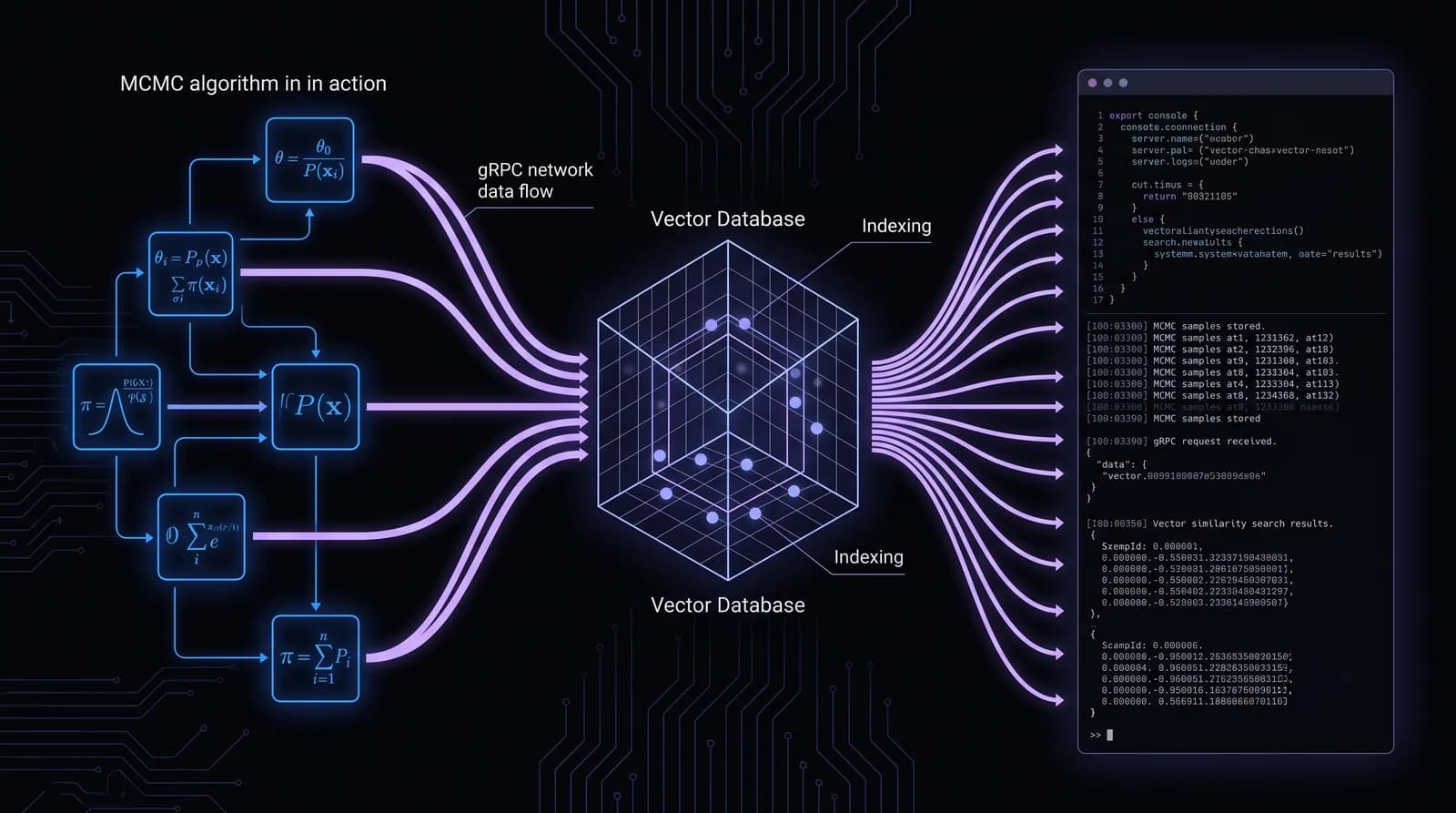
The transition from a highly optimized statistical script running locally in R or Python to a production-ready, distributed web architecture represents one of the most critical engineering hurdles in applied data science. Markov Chain Monte Carlo (MCMC) algorithms, such as Hamiltonian Monte Carlo (HMC) or adaptive Metropolis-Hastings, are inherently sequential, computationally intensive, and heavily reliant on continuous memory allocation. When data science teams attempt to deploy these models as monolithic REST APIs using standard Python (e.g. FastAPI or Flask) or R (e.g. Plumber) environments, the architecture inevitably fractures under concurrent load. The synchronous nature of these runtimes blocks execution threads, resulting in massive memory footprints, dropped connections, and catastrophic degradation in latency.
By 2026, the industry standard for deploying probabilistic models necessitates a strict decoupled, headless architecture. We must separate the heavy mathematical kernels from the network transport layer. The modern paradigm involves encapsulating the statistical algorithms within highly concurrent Go microservices, streaming the generated posterior samples via optimized gRPC channels, persisting the state vectors in PostgreSQL using pgvector, and consuming the convergence metrics via Server-Sent Events (SSE) in a Next.js App Router frontend. This report details the complete engineering pathway to architecting this system.
The Distributed MCMC Engine: Concurrency in Go
To accurately estimate a complex posterior distribution, it is standard practice to run parallel Markov chains initialized from over-dispersed starting points. In traditional big data environments, frameworks like PySpark are often utilized to distribute these chains across data shards. That approach works, and it is worth being precise about what it delivers rather than dismissing it: a 2025 study of distributed Hamiltonian Monte Carlo on PySpark reports roughly 18.7 Effective Sample Size per second (ESS/s) on a synthetic logistic regression with rows and dimensions, across 4 to 32 workers, with an acceptance rate of 0.986. In that same study the distributed baseline outperformed the communication-avoiding variant it was compared against.
The figure is a useful reference point, not a universal ceiling, and it is the number any replacement architecture should be measured against. The costs it carries are structural: JVM overhead per executor, the latency of a distributed filesystem, and a global synchronization barrier at every model update. None of those are inherent to the sampling itself, which is what makes them worth engineering away.
Rewriting the sampling orchestration in Go circumvents these limitations. Go's lightweight goroutines and lock-free channels allow for the execution of thousands of independent Markov chains on a single multi-core machine without the heavy context-switching penalty inherent to OS-level threads.
gRPC Streaming and vtprotobuf Optimizations
For network transport between the statistical engine and the web application layer, REST over HTTP/1.1 is structurally inadequate. REST relies on JSON serialization, which requires computationally expensive string parsing and generates substantial garbage collection (GC) pressure. Instead, gRPC over HTTP/2 provides multiplexed, persistent connections utilizing Protocol Buffers (protobuf) for binary serialization.
The decision to utilize gRPC is driven directly by hardware utilization metrics. Standard protobuf marshaling is fast, but at the scale of MCMC output, where a service might emit tens of thousands of multi-dimensional float arrays per second, memory allocation becomes the primary bottleneck. Implementing the vtprotobuf plugin drastically optimizes this by pooling memory allocations and avoiding repetitive struct creation during the ingress and egress streams.
| Metric | REST (JSON / HTTP/1.1) | Standard gRPC (Protobuf) | Optimized gRPC (vtprotobuf + Memory Pooling) |
|---|---|---|---|
| Serialization Format | Text (JSON) | Binary | Binary |
| Connection Overhead | High (Per Request) | Low (Multiplexed) | Low (Multiplexed) |
| CPU Usage (Egress Stream) | ~3.0 Cores | ~1.6 Cores | ~0.7 Cores |
| Memory Allocation | Continuous GC pressure | Moderate | Minimal (Pooled) |
| Suitability for MCMC | Poor | Good | Excellent |
Below is a production-level Go gRPC service implementation utilizing channels to orchestrate parallel chains while safely handling client disconnects to prevent "zombie" computations from leaking memory.
package main

import (
	"context"
	"math/rand"
	"sync"

	"google.golang.org/grpc/codes"
	"google.golang.org/grpc/status"

	pb "github.com/your-org/mcmc-core/proto" // Assumes vtprotobuf generation
)

type MCMCServer struct {
	pb.UnimplementedMCMCServiceServer
}

// StreamPosterior executes parallel chains and streams samples back to the coordinator.
func (s *MCMCServer) StreamPosterior(
	req *pb.SamplingRequest,
	stream pb.MCMCService_StreamPosteriorServer,
) error {
	var wg sync.WaitGroup

	// Buffered channel to absorb short bursts of network backpressure.
	sampleChan := make(chan *pb.Sample, 5000)

	// Cancelling this context is what tells every chain to stop. It fires on
	// client disconnect through stream.Context(), and on our own return through
	// the deferred cancel below.
	ctx, cancel := context.WithCancel(stream.Context())
	defer cancel()

	// Launch parallel Markov chains.
	for i := int32(0); i < req.NumChains; i++ {
		wg.Add(1)

		go func(chainID int32) {
			defer wg.Done()

			// Pre-allocate the state array to minimise per-iteration allocations.
			state := make([]float64, req.Dimensions)

			for step := int32(0); step < req.Iterations; step++ {
				// Simulate a Metropolis-Hastings proposal step.
				for d := int32(0); d < req.Dimensions; d++ {
					state[d] += rand.NormFloat64() * 0.1
				}

				sample := &pb.Sample{
					ChainId:   chainID,
					Iteration: step,
					State:     append([]float64(nil), state...),
				}

				// The send belongs inside the select, not after it. Written as a
				// bare `sampleChan <- sample` guarded by a separate
				// `select { case <-ctx.Done(): ... default: }`, a disconnected
				// client leaves every producer parked on a full buffer forever:
				// wg.Wait never returns, the channel is never closed, and the
				// goroutines leak. That is precisely the zombie computation this
				// block exists to prevent, so the cancellation has to cover the
				// send itself.
				select {
				case sampleChan <- sample:
				case <-ctx.Done():
					return // Client disconnected; abandon the chain.
				}
			}
		}(i)
	}

	// Close the channel once every chain has finished.
	go func() {
		wg.Wait()
		close(sampleChan)
	}()

	// Stream consumption loop. Returning here runs the deferred cancel, which
	// unblocks any producer still waiting on the send above.
	for sample := range sampleChan {
		if err := stream.Send(sample); err != nil {
			return status.Errorf(codes.Unavailable, "stream send failed: %v", err)
		}
	}

	return nil
}
Dockerizing the MCMC Multi-Language Pipeline
To deploy this architecture, the Go binary must be containerized. When integrating legacy R or C++ statistical libraries (such as RStan or custom Hamiltonian implementations) via cgo, the Docker build process requires a multi-stage approach to ensure the final production image remains lightweight and secure.
The first stage uses a heavyweight compiler image containing the C++ toolchain and the R headers. The critical constraint on the second stage is the C library. A binary compiled with CGO_ENABLED=1 on a Debian builder links against glibc, and Alpine ships musl, so copying that binary into an Alpine image produces a container that fails at startup with a missing-loader error. Beyond that, cgo bindings to R do not statically link: libR.so is a shared object, and the runtime image has to carry it. The alpine plus -extldflags "-static" recipe that circulates for pure-Go services simply does not apply once R is in the picture.
The correct pairing is a runtime image on the same libc as the builder, carrying the R runtime and nothing else:
# Stage 1: build environment
FROM golang:1.24-bookworm AS builder

# The C++ toolchain and R headers the cgo bindings compile against.
RUN apt-get update && apt-get install -y --no-install-recommends \
        build-essential \
        r-base-dev \
        r-cran-rcpp \
    && rm -rf /var/lib/apt/lists/*

WORKDIR /app

COPY go.mod go.sum ./
RUN go mod download

COPY . .

# Dynamically linked on purpose. libR cannot be statically linked into a Go
# binary, so the runtime image below has to provide it.
RUN CGO_ENABLED=1 GOOS=linux go build -o mcmc_engine .

# Stage 2: runtime on the same libc, with the R runtime but no toolchain.
FROM debian:bookworm-slim

RUN apt-get update && apt-get install -y --no-install-recommends \
        ca-certificates \
        r-base-core \
    && rm -rf /var/lib/apt/lists/*

WORKDIR /app
COPY --from=builder /app/mcmc_engine .

EXPOSE 50051
CMD ["./mcmc_engine"]
This drops the image from the multi-gigabyte builder to roughly 400 MB: the compiler, the headers and the R development packages are gone, the R runtime stays because the binary genuinely needs it. The sub-50 MB figure quoted for Go services is reachable only by removing cgo from the equation, which is worth doing whenever the sampler can be written in pure Go. With CGO_ENABLED=0 the binary is fully static, the runtime stage becomes FROM scratch plus a CA bundle, and the image lands around 20 MB. Treat the R bindings as a migration step rather than a permanent architecture.
Dynamic Convergence Diagnostics ()
The greatest risk in automated MCMC deployment is premature termination. Halting the chains before they have converged to the stationary target distribution results in heavily biased parameter estimates, while running the chains indefinitely wastes compute resources and increases infrastructure costs. The industry standard mechanism for determining stationarity is the Gelman-Rubin potential scale reduction factor, .
The mathematical foundation of relies on comparing the variance between multiple independent chains () against the variance within those individual chains (). If the chains have converged to the same posterior space, the between-chain variance and within-chain variance should be nearly identical.
Let represent the number of chains and the number of iterations per chain. The between-chain variance is defined as:
The within-chain variance is defined as:
The pooled marginal variance estimate is calculated as a weighted average:
The potential scale reduction factor is then derived as:
The formulation above is the classic 1992 diagnostic, and it is the version to implement first because it is the one the equations describe. It has two known blind spots that matter in an automated stopping rule. It cannot see a chain whose mean is stable but whose variance is drifting, and it assumes the target has a finite mean and variance, which fails for heavy-tailed posteriors. Both are addressed by the rank-normalized, folded split- of Vehtari et al. (2021): splitting each chain in half turns a within-chain trend into a between-chain difference, and rank normalization removes the moment assumption. That is what posterior::rhat() in R and arviz.rhat in Python compute today, and a production orchestrator should call one of them rather than a hand-rolled formula.
The threshold moved with the diagnostic. The long-standing was relaxed enough to miss trends accounting for up to 30% of the marginal variance; Vehtari et al. recommend , which catches trends at the 2% level. The stopping rule below uses 1.01 for that reason. Anything looser is a decision to accept bias in exchange for compute, which is a legitimate trade but should be made deliberately rather than inherited from a decade-old convention.
In a production environment, this diagnostic cannot be calculated retroactively. It must be computed dynamically on the incoming gRPC stream. As the stream progresses, the running sum of squares for both and is updated, and when the criterion is met across every dimension the orchestrator can assert that the chains have mixed, triggering an early exit signal to terminate the gRPC stream and free the goroutines.
High-Dimensional State Persistence with PostgreSQL 16 and pgvector
Storing the continuous stream of posterior states is challenging. A typical run might generate 10,000 iterations across 4 chains, with each state comprising hundreds of dimensions. Historically, this data was flattened into HDFS or written to blob storage. However, PostgreSQL 16, paired with the pgvector extension (v0.8+), fundamentally changes how we persist and analyze probabilistic distributions.
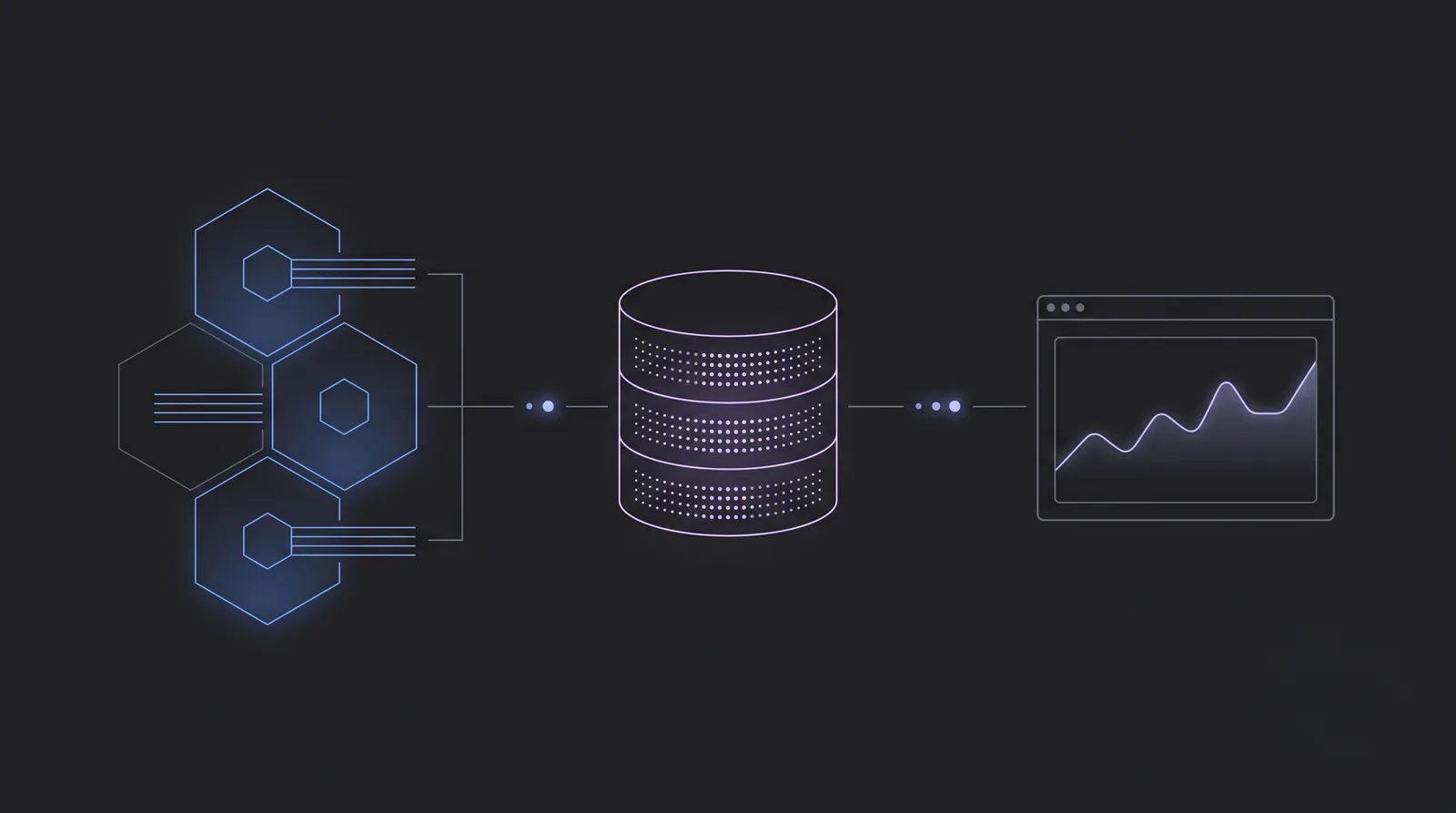
By storing the MCMC state vectors natively using VECTOR types, we can perform advanced analytics directly inside the database. For example, applying k-nearest neighbor (k-NN) queries to the posterior samples allows data scientists to rapidly detect multi-modal distributions or analyze how the trajectory of the chains clusters over time.
To support high-speed querying across millions of samples, a Hierarchical Navigable Small World (HNSW) index is applied to the vectors.
| Index Parameter | Value | Implications for MCMC Posterior Data |
|---|---|---|
| Index Type | hnsw |
Superior to IVFFlat for dynamic streams; does not require a pre-training phase. |
| Distance Metric | vector_l2_ops |
Euclidean distance accurately represents spatial distance between parameter states in the posterior. |
| m | 16 |
Controls the maximum number of bi-directional links created for every element during index construction. 16 balances recall with insertion speed. |
| ef_construction | 64 |
Defines the size of the dynamic candidate list during graph construction. Higher values improve query accuracy at the cost of slower inserts. |
The required database schema is executed via a highly normalized SQL structure, ensuring transactional integrity for the job metadata while providing vector search capabilities for the samples:
-- Enable the pgvector extension for high-dimensional support.
CREATE EXTENSION IF NOT EXISTS vector;

-- Metadata table ensuring strict relational integrity for MCMC runs.
CREATE TABLE mcmc_jobs (
    job_id      UUID PRIMARY KEY DEFAULT gen_random_uuid(),
    model_name  VARCHAR(255) NOT NULL,
    dimensions  INT          NOT NULL,
    status      VARCHAR(50)  DEFAULT 'RUNNING',
    created_at  TIMESTAMPTZ  DEFAULT NOW()
);

-- Time-series table storing individual posterior vectors.
CREATE TABLE posterior_samples (
    sample_id       BIGSERIAL PRIMARY KEY,
    job_id          UUID REFERENCES mcmc_jobs(job_id) ON DELETE CASCADE,
    chain_id        INT NOT NULL,
    iteration       INT NOT NULL,
    -- `vector` stores up to 16,000 dimensions, but an HNSW or IVFFlat index
    -- is limited to 2,000 for this type (4,000 for `halfvec`). Keep the
    -- parameter space inside the index limit, not the storage limit.
    state_vector    VECTOR(256),
    log_likelihood  FLOAT,
    created_at      TIMESTAMPTZ DEFAULT NOW()
);

-- Construct the HNSW index using L2 distance logic.
CREATE INDEX idx_posterior_hnsw
    ON posterior_samples
    USING hnsw (state_vector vector_l2_ops)
    WITH (m = 16, ef_construction = 64);
Bridging the RSC Boundary: Next.js Server-Sent Events
The final architectural component involves delivering the real-time convergence data to the client's browser for visualization. Polling a REST endpoint is highly inefficient, and while WebSockets offer full-duplex communication, they impose substantial infrastructure complexity regarding connection state management, firewall traversal, and load balancer configuration.
Instead, Server-Sent Events (SSE) provide the perfect unidirectional transmission medium. Using the Next.js App Router, we construct an SSE endpoint using the native web ReadableStream API. This technique allows Next.js to incrementally stream data chunks from the server to the client over a standard HTTP keep-alive connection.
A Route Handler is the right home for this specifically because it sits outside the React render path. Server Components render once and finish; a stream that stays open for the length of an MCMC run has no place in that lifecycle. Keeping the connection in a Route Handler and consuming it from a client component with EventSource means the streaming state lives entirely on the client and never participates in server rendering, so there is nothing for the server and client trees to disagree about. Instrumenting the whole path is a separate concern: an OpenTelemetry trace propagated from the Go gRPC call through the Next.js handler is what lets you attribute a stall to the sampler rather than the network.
// app/api/mcmc-stream/route.ts
import { NextRequest } from "next/server";
import { createGrpcClient, createDbPool } from "@/lib/infrastructure";
import { calculateRHat } from "@/lib/statistics";
import type { Sample } from "@/lib/proto/mcmc";

// Force dynamic execution; prevent static caching of the stream.
export const dynamic = "force-dynamic";

export async function GET(req: NextRequest) {
  const encoder = new TextEncoder();
  const jobId = req.nextUrl.searchParams.get("jobId");

  const stream = new ReadableStream({
    async start(controller) {
      const grpcClient = createGrpcClient();
      const db = createDbPool();

      const stateBuffer: Sample[] = [];
      let pending: Sample[] = [];

      // One INSERT per sample would pin the whole stream to a database
      // round trip and throw away the throughput the Go engine was built
      // for. Samples are accumulated and flushed as a single multi-row
      // statement instead.
      const FLUSH_EVERY = 500;

      async function flush() {
        if (pending.length === 0) return;

        const values: unknown[] = [];
        const tuples = pending.map((s, i) => {
          const o = i * 4;
          values.push(jobId, s.chainId, s.iteration, `[${s.state.join(",")}]`);
          return `($${o + 1}, $${o + 2}, $${o + 3}, $${o + 4}::vector)`;
        });

        await db.query(
          `INSERT INTO posterior_samples (job_id, chain_id, iteration, state_vector)
           VALUES ${tuples.join(", ")}`,
          values
        );

        pending = [];
      }

      try {
        const streamCall = grpcClient.streamPosterior({
          numChains: 4,
          dimensions: 256,
          iterations: 10000,
        });

        for await (const sample of streamCall) {
          pending.push(sample);
          stateBuffer.push(sample);

          if (pending.length >= FLUSH_EVERY) await flush();

          // Periodically compute the Gelman-Rubin convergence diagnostic.
          if (stateBuffer.length % 100 === 0) {
            const rHat = calculateRHat(stateBuffer);

            const data = JSON.stringify({
              chain: sample.chainId,
              iteration: sample.iteration,
              primary_dimension: sample.state[0], // Feature extracted for the trace plot.
              rHat,
            });

            controller.enqueue(encoder.encode(`data: ${data}\n\n`));

            // Stopping rule: the rank-normalized split-R-hat threshold from
            // Vehtari et al. (2021), not the older 1.1 convention.
            if (rHat < 1.01 && sample.iteration > 2000) {
              controller.enqueue(
                encoder.encode(`event: convergence\ndata: {"status": "converged"}\n\n`)
              );

              await flush();
              await db.query(
                `UPDATE mcmc_jobs SET status = 'COMPLETED' WHERE job_id = $1`,
                [jobId]
              );

              break; // Gracefully close the gRPC stream.
            }
          }
        }

        await flush(); // Samples left over from the final partial batch.
      } catch (error) {
        console.error("SSE streaming exception:", error);
        controller.enqueue(
          encoder.encode(`event: error\ndata: {"message": "Inference failure"}\n\n`)
        );
      } finally {
        controller.close();
      }
    },
  });

  // Return the standard SSE headers to the browser.
  return new Response(stream, {
    headers: {
      "Content-Type": "text/event-stream",
      "Cache-Control": "no-cache, no-transform",
      Connection: "keep-alive",
      // Without this, Nginx and most edge proxies buffer the response and
      // deliver every event at once when the handler exits, which for a
      // long-running stream means effectively never.
      "X-Accel-Buffering": "no",
    },
  });
}
The client-side architecture subsequently utilizes EventSource and React Suspense to render dynamic, non-blocking trace plots as the data streams in. This provides the data scientist with immediate visual confirmation of chain mixing and stationarity without requiring the entire dataset to be loaded into browser memory.
To summarize, engineering a modern probabilistic pipeline is an exercise in strict system decoupling. By combining the low-latency concurrency of Go, the binary efficiency of gRPC, the advanced high-dimensional indexing of PostgreSQL pgvector, and the seamless streaming capabilities of Next.js Server-Sent Events, we construct a resilient architecture capable of deploying advanced statistical models into the most rigorous production environments.
References
27
- MCMC Methods: From Theory to Distributed Hamiltonian Monte Carlo over PySpark - Algorithms (MDPI)doi.org
- Rank-normalization, folding, and localization: An improved R-hat for assessing convergence of MCMC - Vehtari, Gelman, Simpson, Carpenter and Burknerarxiv.org
- Rank-normalization, folding, and localization: online appendix and codeavehtari.github.io
- posterior::rhat - Rhat convergence diagnostic, Stanmc-stan.org
- arviz.rhat - ArviZ documentationpython.arviz.org
- Threshold for R-hat (1.01 or 1.05) - stan-dev/rstan issue 812github.com
- Revisiting the Gelman-Rubin Diagnostic - arXivarxiv.org
- Gelman and Rubin Diagnostics - SAS/STAT user's guide extract, Imperial College ICICimperial.ac.uk
- Stopping Rules for Monte Carlo Methods: A Review - arXivarxiv.org
- High Performance gRPC - FOSDEM 2025archive.fosdem.org
- REST vs gRPC Performance in Go: A Practical Benchmark-Driven Guide - DEV Communitydev.to
- planetscale/vtprotobuf: A Protocol Buffers compiler that generates optimized codegithub.com
- gRPC Go: Basics tutorial and server-side streaminggrpc.io
- Go Documentation: the context packagepkg.go.dev
- Go Blog: Go Concurrency Patterns, pipelines and cancellationgo.dev
- cgo - Go Command Documentationpkg.go.dev
- Statically compiled Go programs, always, even with cgo, using musl - Dominik Honnefhonnef.co
- Multi-stage builds - Docker Docsdocs.docker.com
- pgvector/pgvector: Open-source vector similarity search for Postgresgithub.com
- An early look at HNSW performance with pgvector - Jonathan Katzjkatz05.com
- Writing R Extensions: linking against the R librarycran.r-project.org
- Guides: Streaming - Next.jsnextjs.org
- Route Handlers - Next.jsnextjs.org
- Real-Time Notifications with Server-Sent Events (SSE) in Next.js - Pedro Alonsopedroalonso.net
- MDN: Using server-sent eventsdeveloper.mozilla.org
- nginx: ngx_http_proxy_module, proxy_buffering and X-Accel-Bufferingnginx.org
- OpenTelemetry: distributed tracing conceptsopentelemetry.io